



Ideas
Opened Catechism

The Church of Christ (from the Catechism)

The Church

The Sacrament of Salvation

The Church - human and divine
These dimensions together constitute "one complex reality which comes together from a human and a divine element":
"The Church is essentially both human and divine, visible but endowed with invisible realities, zealous in action and dedicated to contemplation, present in the world, but as a pilgrim, so constituted that in her the human is directed toward and subordinated to the divine, the visible to the invisible, action to contemplation, and this present world to that city yet to come, the object of our quest." (Vatican II, the Sacred Liturgy)

"O humility! O sublimity! Both tabernacle of cedar and sanctuary of God; earthly dwelling and celestial palace; house of clay and royal hall; body of death and temple of light; and at last both object of scorn to the proud and bride of Christ! She is black but beautiful, O daughters of Jerusalem, for even if the labour and pain of her long exile may have discoloured her, yet heaven's beauty has adorned her." (St Bernard) (771)

The Church - mystery of our union with God
It is in the Church that Christ fulfils and reveals his own mystery as the purpose of God's plan: "to unite all things in him" (Eph 1:10). St. Paul calls the nuptial union of Christ and the Church "a great mystery" (Eph 5:32). Because she is united to Christ as to her bridegroom, she becomes a mystery in her turn. Contemplating this mystery in her, Paul exclaims: "Christ in you, the hope of glory" (Col 1:27). (772)
The ‘Marian’ dimension of the Church
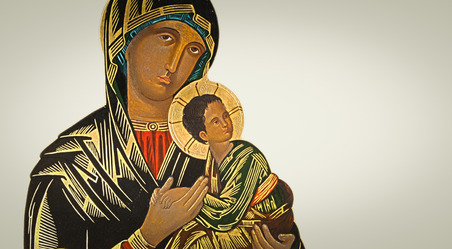
In the Church this communion of men with God, in the "love [that] never ends", is the purpose which governs everything in her that is a sacramental means, tied to this passing world. "[The Church's] structure is totally ordered to the holiness of Christ's members. And holiness is measured according to the 'great mystery' in which the Bride responds with the gift of love to the gift of the Bridegroom". Mary goes before us all in the holiness that is the Church's mystery as "the bride without spot or wrinkle". This is why the "Marian" dimension of the Church precedes the "Petrine". (Pope John Paul II) (773)
The universal Sacrament of Salvation
The Greek word mysterion was translated into Latin by two terms: mysterium and sacramentum. In later usage the term sacramentum emphasises the visible sign of the hidden reality of salvation which was indicated by the term mysterium. In this sense, Christ himself is the mystery of salvation: "For there is no other mystery of God, except Christ". (St Augustine)

The saving work of his holy and sanctifying humanity is the sacrament of salvation, which is revealed and active in the Church's sacraments (which the Eastern Churches also call "the holy mysteries").

The seven sacraments are the signs and instruments by which the Holy Spirit spreads the grace of Christ the head throughout the Church which is his Body. The Church, then, both contains and communicates the invisible grace she signifies. It is in this analogical sense, that the Church is called a "sacrament". (774)
The sacrament of unity of the human race with God
"The Church, in Christ, is like a sacrament - a sign and instrument, that is, of communion with God and of unity among all men" (Vatican II, the Church). The Church's first purpose is to be the sacrament of the inner union of men with God. Because men's communion with one another is rooted in that union with God, the Church is also the sacrament of the unity of the human race. In her, this unity is already begun, since she gathers men "from every nation, from all tribes and peoples and tongues" (Rev 7:9); at the same time, the Church is the "sign and instrument" of the full realisation of the unity yet to come. (775)
The visible plan of God’s love for humanity
As sacrament, the Church is Christ's instrument. "She is taken up by him also as the instrument for the salvation of all", "the universal sacrament of salvation", by which Christ is "at once manifesting and actualising the mystery of God's love for men". The Church "is the visible plan of God's love for humanity", because God desires "that the whole human race may become one People of God, form one Body of Christ, and be built up into one temple of the Holy Spirit". (Pope Paul VI) (776) In brief - The Church is both visible and spiritual, a hierarchical society and the Mystical Body of Christ. She is one, yet formed of two components, human and divine. That is her mystery, which only faith can accept. (779)
The Church in this world is the sacrament of salvation, the sign and the instrument of the communion of God and men. (780)
The Church - both Visible and Spiritual

The Church is in history, but at the same time she transcends it. It is only ‘with the eyes of faith’ that one can see her in her visible reality and at the same time in her spiritual reality as bearer of divine life. (770)
"The one mediator, Christ, established and ever sustains here on earth his holy Church, the community of faith, hope and charity, as a visible organisation through which he communicates truth and grace to all men". (Vatican II, the Church) The Church is at the same time:

a "society structured with hierarchical organs and the mystical body of Christ;

the visible society and the spiritual community;

the earthly Church and the Church endowed with heavenly riches". (Vatican II, the Church)