


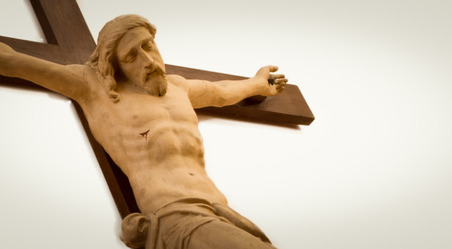

Keeping Christ At The Centre
Editorial FAITH Magazine September-October 1998 by Tim Finigan
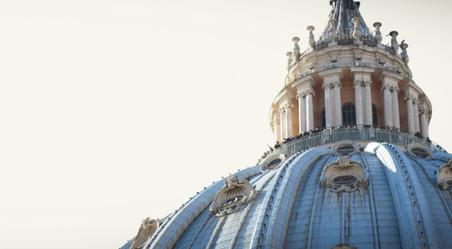
When clergy attempt to enter the world of commerce or business, the results can sometimes be comical. It is not our vocation and we can misunderstand things naively to the entertainment of those in the know. Conversely, however, comments from the business world on matters ecclesiastical can also sound comical. Recently, one of the organisers of the Millennium Dome was quoted on his reasons for not attempting to give a higher profile to the “Spirit Zone”. He felt that the Dome really had nothing much to do with Christianity and that it would be wrong to attempt anything. “The Vatican has its own product” was the way he attempted to explain the uniqueness of the Catholic Church’s contribution to the Millennium. He felt that this Vatican product had a life and context of its own—nowhere near the Dome.
Odd though the language may be, he might well have hit upon an important truth that is missed by many Christians and indeed many Catholics. We do have a “unique product”. Throughout his pontificate, especially in the encyclicals Redemptor Hominis and Dominum et Vivificantem, the Holy Father has seen the celebration of the jubilee as the central focus which gives meaning to his Petrine ministry at this particular time in history. The encyclical Tertio Millennio Adveniente elaborated the meaning of the jubilee specifically and taught the essential meaning of the celebration of the year 2000.
First of all, the event from which our years are numbered, the Incarnation of the Word of God is presented as the key to the meaning of the universe:
The fact that in the fullness of time the eternal Word took on the condition of a creature gives a unique cosmic value to the event which took place in Bethlehem 2,000 years ago. Thanks to the Word, the world of creatures appears as a “cosmos,” an ordered universe. And it is the same Word who, by taking flesh, renews the cosmic order of creation. The Letter to the Ephesians speaks of the purpose which God had set forth in Christ, “as a plan for the fullness of time, to unite all things in him, things in heaven and things on earth” (1:9-10). (Tertio Millennio Adveniente 3)
It is through the Word that the universe is an ordered creation, a cosmos. The universe is not a random collection of energies but exists in the first place and continues to exist and develop according to the mind and the wisdom of God. It finds its purpose in God, “set forth in Christ”. This idea is fundamental to the Faith Movement and is the idea expressed in our own teaching as the “unity law of control and direction”, a law which runs throughout creation and in the order of grace to bring all things to their fulfilment in Christ.
The Holy Father answers the fundamental question “Who is Jesus Christ” in terms of this understanding of the universe and of human history:
Christ, true God and true man, the Lord of the cosmos, is also the Lord of history, of which he is “the Alpha and the Omega” (Rev 1:8; 21:6), “the beginning and the end” (Rev 21:6). In him the Father has spoken the definitive word about mankind and its history. (Tertio Millennio Adveniente 5)
Fr Roger Nesbitt and Fr Ian Vane’s Panorama of Creation and Salvation History, published by Faith-Keyway publications (see advertisement on page 22) is a graphic presentation of this teaching on the place of Jesus Christ, the Word of God. It also expresses the Christian concept of time which finds its meaning in the Incarnation. As the Holy Father says:
Time is indeed fulfilled by the very fact that God, in the incarnation, came down into human history. Eternity entered into time: What “fulfilment” could be greater than this? (Tertio Millennio Adveniente 9)
Therefore we have the duty to sanctify time. The idea of creation as a cosmos, set forth in Christ who is the Lord of history is not a religious gloss on the chance arrival of a round figure in the calendar: Christ gives the fundamental meaning to our measurement of time in the first place and therefore we celebrate and sanctify significant anniversaries.
This point is important because the presumption in Britain is that there is a secular celebration onto which Christians may attach their own particular “brand” of product. We would see it on the contrary as a festival which has no meaning apart from Christ. We believe that time itself has no meaning apart from Jesus Christ and therefore the advent of the 2000th anniversary of the Incarnation certainly cannot be considered in any way except as a celebration of the Incarnation and of the work of God for our Salvation. This work of God finds its fulfilment in the Eucharist. In that sacrament, God makes his saving work present and effective for us through all time. We live and move and have our being in God who is the proper environment or, as we might say “Environer”, of the human person. In the Word made flesh, God “sets up his tent among us” to bring his salvific presence to us. The Holy Eucharist is the living presence of Christ the Lord of the cosmos and of history who nourishes his people with his own life. Therefore the celebration of the Jubilee cannot but be a Eucharistic celebration:
But since Christ is the only way to the Father, in order to highlight his living and saving presence in the church and the world the International Eucharistic Congress will take place in Rome on the occasion of the Great Jubilee. The year 2000 will be intensely eucharistic: in the sacrament of the Eucharist the Saviour, who took flesh in Mary’s womb 20 centuries ago, continues to offer himself to humanity as the source of divine life. (Tertio Millennio Adveniente 55)
In the celebration of the Jubilee, it is right that the dimension of social justice also plays a major part. However, it would miss the point entirely if this dimension were seen as somehow separate from or a replacement for the principal meaning of the Jubilee. It is unlikely that anyone would actually express this opinion in theory but in practice, many of the materials produced for the Jubilee seem to focus on this social justice dimension without making clear why it is that social justice is a part of the celebration of the year 2000.
It is not simply a question of an old tradition of jubilees. It is rather the underlying reason for that tradition and its fulfilment in Jesus Christ. Christ is the Lord of creation and therefore the ownership of the goods of creation is in the gift of God himself. His gift is to the whole of humanity:
It was a common conviction, in fact, that to God alone, as Creator, belonged the “dominium altum”—lordship over all creation and over the earth in particular (cf. I v. 25:23). If in his providence God had given the earth to humanity, that meant that he had given it to everyone. Therefore the riches of creation were to be considered as a common good of the whole of humanity. (Tertio Millennio Adveniente 13)
The consequence of this is that even a legitimately title to private property does not confer on us an absolute ownership of the worlds goods. What we own, we own as stewards
Therefore the riches of creation were to be considered as a common good of the whole of humanity. Those who possessed these goods as personal property were really only stewards, ministers charged with working in the name of God, who remains the sole owner in the full sense, since it is God’s will that created goods should serve everyone in a just way.
The social justice dimension of the Jubilee year and indeed the whole social teaching of the Church is rooted in this vision of Christ as the Lord of creation.
The jubilee year was meant to restore this social justice. The social doctrine of the church, which has always been a part of church teaching and which has developed greatly in the last century, particularly after the encyclical Rerum Novarum, is rooted in the tradition of the jubilee year. (Tertio Millennio Adveniente 13)
In addition, the coming of Christ in the Incarnation added a further dimension to the Lord’s year of favour. The meaning of the Jubilee is not confined to social justice but also extends beyond the demands of justice to the gratuitously conferred mercy of God who forgives our sins. Hence “The tradition of jubilee years involves the granting of indulgences on a larger scale than at other times.” Tertio Millennio Adveniente 14)
The Jubilee of the year 2000 is fundamentally a celebration of the Lordship of Christ over all creation. Through advances in the natural sciences, we have become aware in this century more than any other of time itself as an aspect of the material creation. It is right, therefore that the celebration of the millennium should be enriched by a development of the doctrine of creation which sees in a more unified way than before the wisdom of God expressed through his Word in the order of creation and of grace.
This fundamental meaning of the Jubilee leads to a celebration which is “intensely Eucharistic” and involves also the dimension of pardon and of peace given through the sacramental ministry of the Church both in the granting of absolution and the granting of indulgences. Indeed the meaning of the indulgence itself needs to be seen more coherently in the context of God’s saving work in history.
We can see the demands of social justice clearly linked to the Lordship of Christ over all creation. Most basic of all the demands of justice is the right of every created human person to life and this must form a part of our commitment to social justice. Then also a Christian understanding of ownership and society should be an integral part of our approach to the Jubilee. It is “integral” because it is a consequence in practice of the dominion of God over all creation.
The “Vatican’s unique product” is in fact a consequence of God’s unique product: creation.